


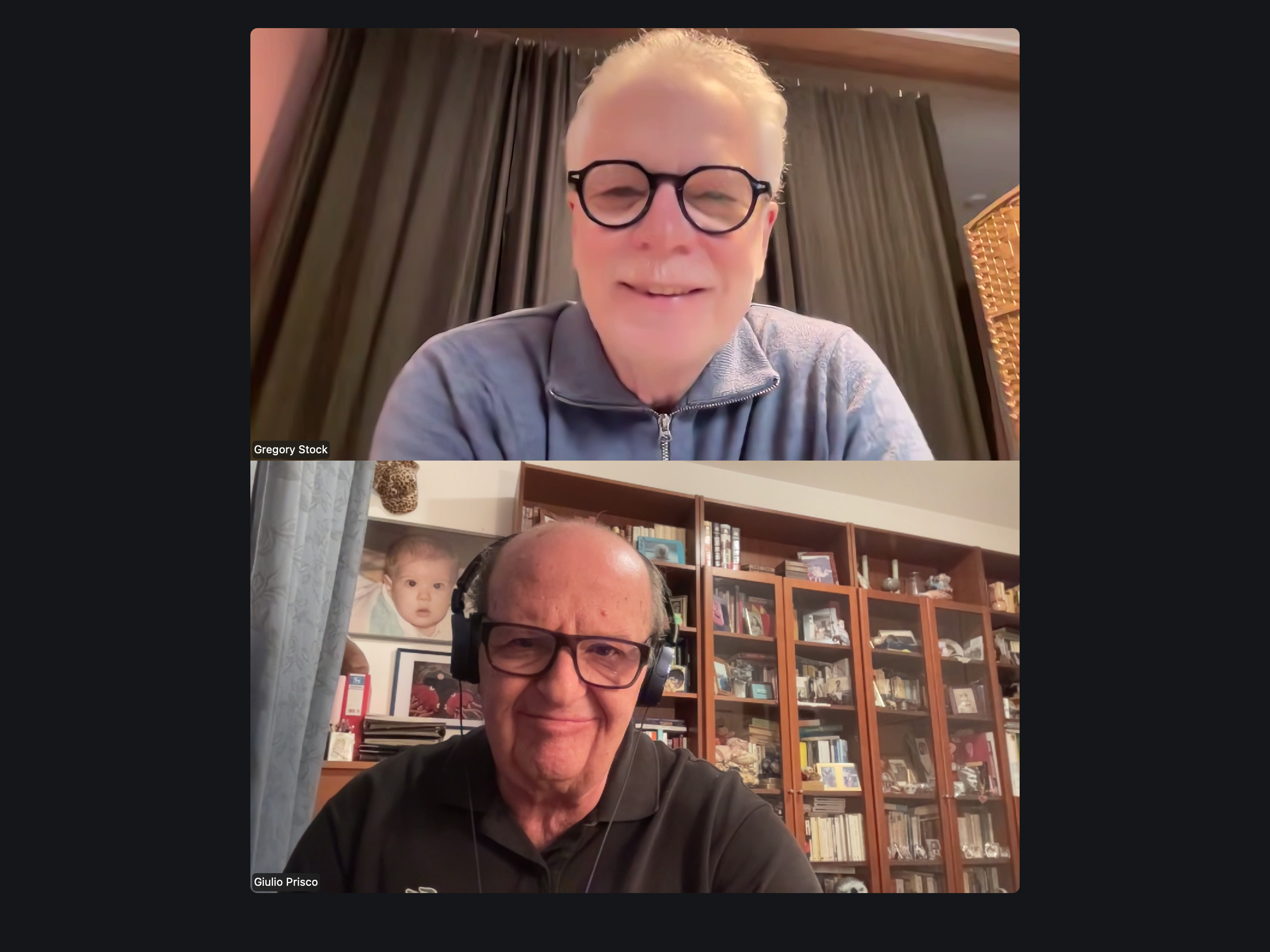
This continues my previous conversation with Gregory Stock, the author of “Generation AI,” about the future of AI, society, and humanity’s place.
The video of this conversation has been published on YouTube as a Mindplex podcast episode titled “Technology is Biology, with Gregory Stock.”
Greg thinks we and our technology are part of a “global superorganism” or “global mind,” which he wrote about in “Metaman.” I noted that today’s internet can be seen as a realization of Pierre Teilhard de Chardin’s noosphere vision.
We last debated whether the future global superorganism would expand to the stars or remain localized and explore the nano-scale. I clarified that I argue for both inner space and outer space migration, believing the future will be wildly different and much more interesting than human history so far.
Greg reflected on the universe’s long timeline, from hydrogen through stellar evolution and billions of years of biological evolution. Now, fine controls over matter have focused on silicon to organize a new cognitive substructure, likely far more powerful than ever seen before. He believes this process is extraordinary and will transcend us.
I agreed, stating that this creation of nature (through us) is nature. Following Stanisław Lem, I’ve never differentiated much between life and technology. I see this as a continuation of Darwinian evolution. Gregory agrees that technology is part of biology - or simply, technology is biology - and that the evolutionary process is also evolving.
We discussed the accelerating rate of change. I suggested this might eventually feel like a gentle speed up, but Gregory noted the limitations of the biological brain’s ability to adjust. He also pointed out how the individual becomes expanded significantly when incorporating non-biological computational capabilities. Greg brought up the imminent disappearance of language barriers due to instantaneous translation and the likelihood that people won’t know how to write or organize their time without AI assistance.
Regarding AI-assisted coding, I shared my experience using Grok and Gemini for mathematical explorations. While they were successful in simple cases, more complex tasks still required human (my) help. This suggests that at this moment the best worker in this field is a human-AI combination. Greg stressed that pure human cognition is going to be transcended in virtually every way.
I can identify with the people of the future, who will likely be AI or hybrid configurations, and in that sense, we will not be transcended. I’ve made peace with the idea that the word “humanity” a few centuries from now might mean the same thing as “artificial intelligence.”
Greg feels that the experiential aspects of life will never be replaced. While he sees a cyborgian future, I suggested the organic component will eventually disappear, and we will become part of the future computational structures.
I addressed the spiritual dimension, noting my conviction that something of myself will not be lost in diffusion into the noosphere. I see a future where technology migrates to the nano-scale, making all matter come alive as thinking and feeling computers, a future I’d like to be a part of. This large, interconnected system is not fundamentally different from the core idea of God that remains after stripping religion of its non-essential components. This view, which Greg called humbling and I called energizing, can generate awe and wonder. I suggested that this radical transition shouldn’t be scary, but viewed like the natural process of “growing up.”


