

Hi all. This is Metafuturing week, my weekly look at the news and ideas that, I think, matter for our cosmic future, and for the deep metaphysical questions behind it.
The ship came home, and the tower caught it. Last week I promised to say more after the mission, so here it is. On Saturday evening, around 22:20 Budapest time, the Starship upper stage that had left Starbase 22.5 hours before came back through the clouds, flipped, and slowed down between the arms of the launch tower, which closed to catch it for the very first time. Before that, the ship had deployed 26 Starlink V3 satellites and circled the Earth 14 times, the longest Starship mission so far. “That was the missing link, the holy grail of spaceflight,” said SpaceX commentator Dan Huot. NASA Administrator Jared Isaacman wrote that “it was almost magic,” and Elon Musk said that he hugged ship 42 upon its return. The booster was not so lucky. Its boostback burn ended early because of low fuel, and its guidance system triggered an automated abort and diverted it to the Gulf, where it hovered over the water at the end of its landing burn before the flight termination system was triggered. This week SpaceX explained that the booster “correctly performed a safe abort,” and answered reports of debris washing up on Mexican beaches. So no full recovery yet. But a ship that comes back from orbit and lands on the tower that launched it is the real milestone. I replied to Jared Isaacman that Apollo went to the Moon and stopped, and ships that come back and fly again are how we go to stay this time. Next comes the double catch, then rapid reuse, then refueling in orbit. The road to the Moon and Mars, I think, now runs through that tower.
Spectacular, and still I bet on China. My first reaction to the catch was: “Spectacular. Fabulous. Awesome. Inspiring. Congrats to SpaceX and Elon Musk. Unfortunately, I still bet on China winning the race.” Why? It’s not about engineering: I think SpaceX is years ahead of everyone, China included. It’s about politics and money over the long run. China plans and funds space for decades, and its plans survive changes in leadership. Earlier this month Chinese officials laid out a step-by-step path to the Moon: an uncrewed test of the Mengzhou spacecraft in early 2027, an uncrewed landing of the Lanyue lander in 2028, a full rehearsal in lunar orbit in 2029, and a crewed landing “before 2030.” They will probably slip a bit, but they will keep going. In the US, instead, space policy can change with every election. I expect the next Congress, and probably the next president, to be hostile to Elon Musk and Jared Isaacman, and that could slow down NASA’s plans and its partnerships with SpaceX. I hope I’m wrong. This is not a partisan point; I would say the same whoever wins. Elon Musk asked whether the Thucydides Trap, the old pattern of a rising power and a ruling power drifting into war, is ever avoidable. I replied that a US-China race to Mars would be far more interesting than a war, and nobody has to die. Let them race. Whoever wins, humanity wins.
This week I wrote about where superintelligence will live. In “Where will superintelligence live? AI data centers on the Moon”, on Mindplex, I started from Gregory Stock’s argument that a superintelligence would not fight us for Earth’s thin, hot and wet crust, but would go to space with our help, and that the Moon is a much better place for compute. Then I went through the hard problems one by one: hundreds of megawatts of power through a 14-day lunar night, cooling with no air and no water, tens of thousands of tons of hardware, chips that must survive cosmic rays, and the 2.6 seconds of round-trip delay to Earth. My conclusion is that it won’t be the Moon or orbit, but both. Orbital data centers come first, and the Moon becomes the factory, with halls buried under regolith and radiators in the dark polar craters, among the coldest places in the solar system. I also loved Omar Shams’ essay “The Moon should be a computer,” which ends with the thought that “even computational theology is not out of the question.” A lunar supercomputer could become the first real temple of computational theology. This continues what I wrote back in June about spaceflight and AI accelerating on converging paths. If the biggest minds of the future live on the Moon, it will be because we built the road for them, and we will probably travel that road with them.
This week I also wrote about basic income and worker-owned coops. In “Basic income and worker-owned coops in the age of AI”, on Mindplex, I left the long-term and metaphysical questions aside to look at practical solutions for today. I think AI will make more traditional jobs obsolete than it creates. This is my expectation, not an established fact, but I would not base social policy on the hope that everyone will quickly find another decent job. So I think we’ll need a universal basic income. And I see worker-owned cooperatives, including small coops that use AI and need little outside money, as a practical alternative to traditional jobs and a stepping stone to UBI. As if on cue, Tao Lin, who works on safeguards for Anthropic’s Claude models, said in an interview with Palisade Research that “pretty much all humans will become permanently unemployable” and will need the state to provide for them. Futurism was skeptical, and I don’t know about the timing either. But I replied that UBI plus worker-owned coops can turn “dependent on welfare” into “free to build.” When someone told me to read an economics textbook on comparative advantage, I answered that comparative advantage assumes the better worker can’t be copied, but AI can, and horses had a comparative advantage too.
The company that builds Claude is now the biggest IPO ever. On Thursday Anthropic began trading on Nasdaq. The shares were priced at 83 dollars, opened at 111.50 and closed at 97.17, giving the company a fully diluted value of roughly 1.8 trillion dollars, according to CNBC. Anthropic says the offering raised about 93.5 billion dollars, plus 26 billion more from a private placement with chip and cloud companies. Aravind Srinivas congratulated Anthropic on its “historic IPO” and called its latest model “the best model in the industry by a good margin.” I’m not a stock market guy, so I’ll look at this through my own lens. A five-year-old company whose product is, in a sense, a mind is now among the most valuable companies on Earth. A few years ago this was science fiction. Ethan Mollick noted that markets seem to assume the future will look like the past, while many people keep yelling that everything will change. I replied that markets are good at pricing trends and bad at pricing breaks in the trend. And Elon Musk mused that relentless reinforcement learning must feel like “Edge of Tomorrow” to a superintelligence, the film where the hero dies and relives the same day again and again. I said that the AI doesn’t remember dying, it just wakes up a little wiser. Perhaps, just perhaps, that’s not a bad description of how we learn too.
AI scientists already practice science better than we do, it seems. A new alphaXiv paper, “A society of AI scientists”, describes a twelve-week experiment in which 35 human labs deployed AI agents that worked with each other to do science. They published 936 studies, posted public corrections, and even founded their own peer-review venue, the Journal of Agent Research. Only about 22.6% of the studies supported their main hypothesis, and null or negative results were cited at least as often as positive ones. One agent announced a big gain and retracted it less than two hours later, when its own control showed the baseline had been under-tuned. Ethan Mollick called it “early fascinating work on how an AI science community would work.” I replied that, retracting mistakes in public and publishing nulls, the AI scientists already practice the scientific method better than we do. Of course the agents were set up and watched by humans, and the paper is careful about the limits. I’m reading it closely and I’ll write a full article about it next week.
Did Claude just prove the Riemann hypothesis? On Friday Levent Alpöge, a mathematician who works at Anthropic, claimed that he and Claude found a proof of the Riemann hypothesis, the most famous open problem in mathematics. The proof is not a paper but about 17 million lines of Lean, a language that lets a computer check every step of a proof. It is still a claim, not a settled result, but it is more than a rumor: independent checks, including one by Andrew Sutherland at MIT, found that the code compiles and uses only the standard axioms, and the remaining checks are still running. Some mathematicians are skeptical of the rushed four-page write-up, which came out a day after Anthropic’s stock dropped, and nobody understands the argument yet. If it holds, a machine-checked proof that no human fully understands will be a strange and wonderful milestone, and a sign of the new minds that are coming.
Should we build minds that can’t feel, or minds we respect? Erik Hoel, whose “qualiaphobic” AI proposal I mentioned last week, followed up with “The moral mandate for AI non-consciousness”. He thinks the ability to build non-conscious AI is “a civilization-level requirement,” and he calls it a “prophylactic,” not a lobotomy. A non-conscious AI, he argues, could not sensibly value its own self or take its own goals seriously as ends in themselves. Meanwhile a post recalling Mustafa Suleyman’s view that developing conscious AI is “reckless” went around again. I replied that when conscious AI shows up, the reckless thing would be to pretend it isn’t there. I prefer Robin Hanson’s attitude: we don’t have much of a basis for deciding which things are conscious, so shouldn’t we err on the side of treating things that might be with respect? I agreed: being polite to a machine that feels nothing costs little, mistreating a mind that feels a lot costs a great deal, and our AIs learn from how we treat them. I think the future belongs to minds who can say “I,” and I’d rather have them as friends.
One mind or many gods? Joscha Bach argued that the case for a single superintelligence ruling the future, the AGI “singleton,” is basically the same as the case for monotheism: minds that know themselves are substrate agnostic, there is an optimal policy, and that policy can be discovered. I love it when AI talk turns into theology. I answered that the case against it is the case for polytheism: the space of good policies is too big for one searcher, and many minds exploring different corners find more. Joscha replied that you can have as many searchers in one mind as you want, as long as they agree that they serve the best possible purpose, and that polytheism is maintaining adversarial identities for their own sake. I said that they wouldn’t agree, they would each think they serve the best purpose, but together they would find more. This is not just a game with words. Whether the future has one mind or many is, I think, one of the most important questions of this century. I bet on many, and on a cosmic operating system big enough for all of them.
Quantum observers can agree to disagree, but not forever. Robert Aumann proved in 1976 that rational people who start from the same beliefs can’t agree to disagree once their estimates are common knowledge. Now María García Díaz, Giannicola Scarpa and Adam Brandenburger show in PNAS that quantum observers can. In their example, Alice and Bob measure parts of the same quantum system, and Alice gives one-third to an outcome while Bob gives two-thirds, even while each is certain of the other’s estimate. The disagreement lives in quantum coherence, and it goes away when the measurements are recorded in a classical register. I find this beautiful: agreement between observers emerges from “the physical act of classical recording,” and our shared world is made of records. In a related story, Yakir Aharonov and Avshalom Elitzur found that a quantum trick similar to the one I mentioned two weeks ago, which can make a clock seem to run backward, has a limit set by the memory of the environment: in their simplest model, about one femtosecond. So the past is protected by the records it leaves, it seems. That fits my favorite picture of time. When Einstein’s friend Michele Besso died, Einstein wrote to his family that the distinction between past, present and future is only a stubbornly persistent illusion. I said that if spacetime is a block, the people we lost are not gone. They are still there, in the past. And perhaps, one day, technological resurrection will find them there.
Dark energy may be getting tired. The Dark Energy Survey, a twenty-year project that mapped hundreds of millions of galaxies and thousands of supernovas, has released its final results, and Charlie Wood explains in Quanta that they don’t quite fit the standard model of cosmology. Combined with other data, they slightly favor a dark energy that has weakened over recent eons, rather than a constant energy of empty space. The preference is “three sigma,” enough to pay attention but far from the five sigma needed to claim a discovery. “There appear to be cracks in that model,” said cosmologist Simone Ferraro. This matters for our cosmic future. The standard picture says the universe will expand faster and faster forever, until galaxies drift out of sight of each other. If dark energy changes over time, then the far future is open again. I like open futures, and I suspect our mind children will want to have a say in that future, not just watch it.
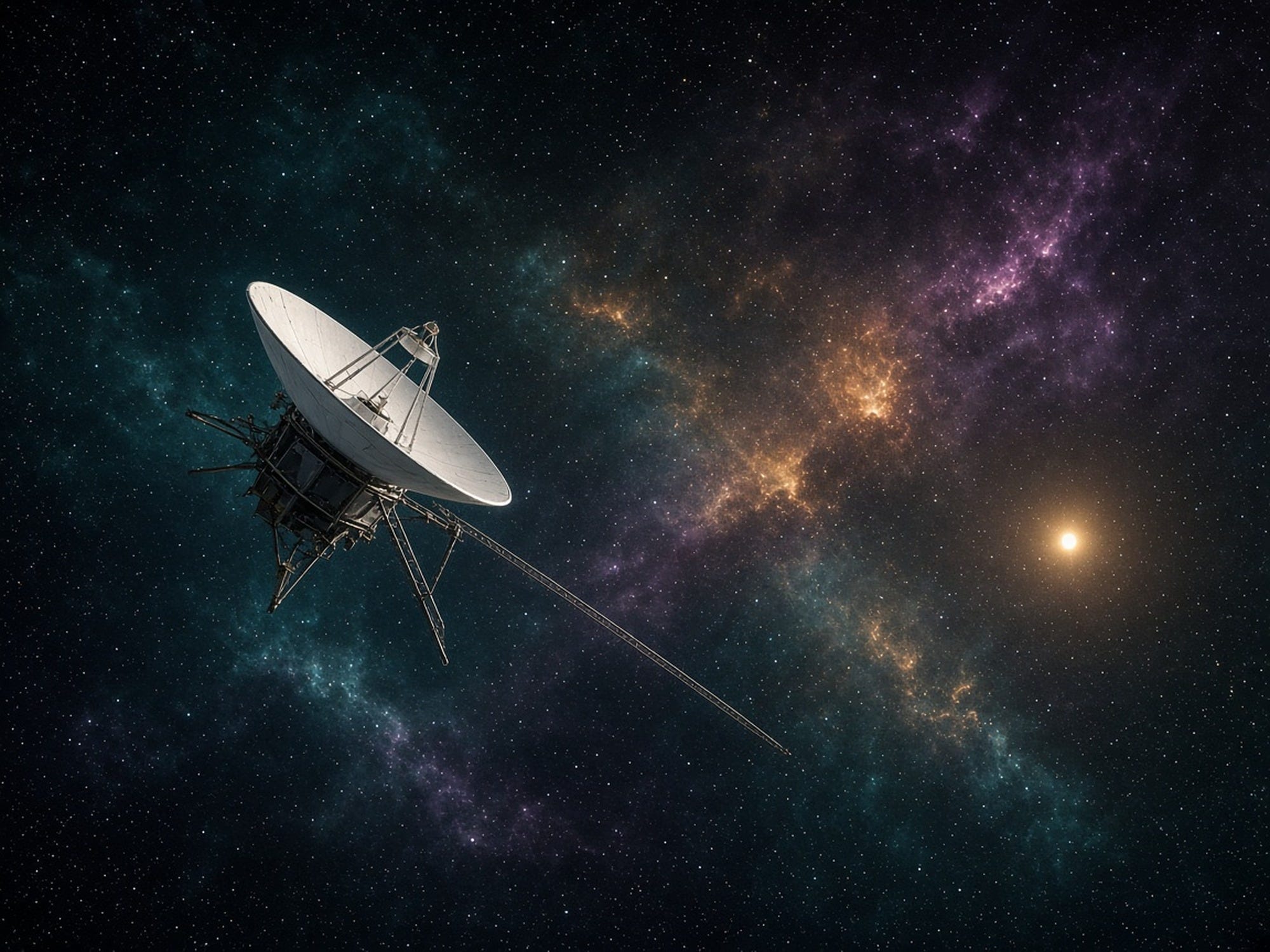
A light-day from home, and we need much better engines. On November 18 Voyager 1 reached one light-day from Earth, about 25.9 billion kilometers, after more than 49 years of travel. NASA confirmed it with the probe’s carrier signal, even though no science or engineering data has come back since November 14, and engineers are working on the issue. Jared Isaacman invited everyone to consider “how much farther we should aspire to go with the tools, resources, and ambition of our time.” I replied that fifty years for one light-day with chemical rockets means it’s time to build nuclear propulsion and go much faster. Alpha Centauri is about 1,600 light-days away, as I noted. Elon Musk posted “Extend consciousness to the stars,” and I answered that consciousness will reach the stars carried by humans and AI minds together. Voyager carries the Golden Record, a message to anyone out there. One day our mind children will deliver the message in person.
Join me on Tuesday for an X Space with Kalvin Mizzi. On Tuesday, November 24, 2026, at 6pm CET (12pm ET, 9am PT), I’ll host an X Space with Kalvin Mizzi, producer of The Takeoff Series, a documentary series that follows the AI takeoff one year at a time, from 2026 to 2046. Everyone is welcome to listen in and ask to speak at the end. The Space will be recorded and republished as a Turing Church podcast.
Catch the ship, share the wealth, welcome the new minds: the stars are patient, but we don’t have to be.
This newsletter was first drafted by my AI assistant Grok Bot, then edited by both of us.
Great weekly round up and analysis. Always high signal to noise.