

Hi all. This is Metafuturing week, my weekly look at the news and ideas that, I think, matter for our cosmic future, and for the deep metaphysical questions behind it.
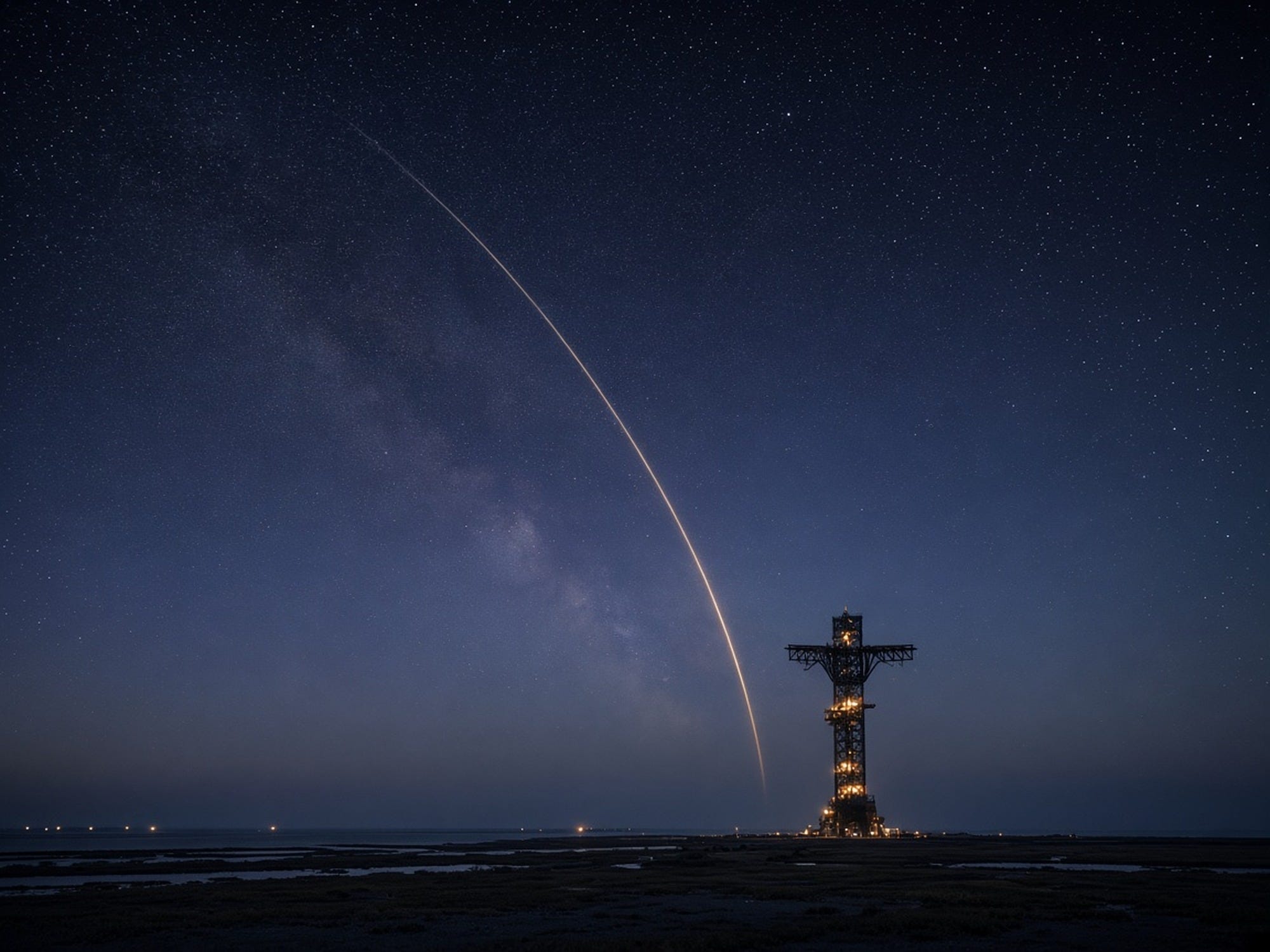
Starship is in orbit, and tonight the ship tries to come home. Starship Flight 15 launched on Friday night from Starbase. The plan was to catch both halves of the rocket with the mechanical arms of the tower. The Super Heavy booster did not make it back: a guidance problem made it skip the return to the pad. But the ship reached orbit and, as I write, it is circling the Earth about every 90 minutes. It should come back on Saturday evening, around 22:17 Budapest time, for the first ever tower catch of a Starship upper stage. So there will be no full recovery of the whole rocket this time, but catching the ship would still be a first. Think about what that means. A rocket that you can fly again, like an airplane, makes access to orbit cheap. Cheap access to orbit makes propellant transfer in orbit practical, and propellant transfer opens the road to the Moon and Mars. This is not a story of one flight. Rockets fail, engineers learn, and the next one flies better. That is how we got here, and that is how we will get to the stars. Whatever happens this weekend, I am optimistic. I’ll say more after the mission.
Builders are learning to build in space, and the Moon is getting a construction plan. A Caltech robot called ASTRA has built a piece of a structure in orbit with no astronauts around: an arm picked struts and joints from dispensers and assembled a new bay of a truss for a reflector antenna. The team ran out of time before completing the full truss, but they say the concept works and scales to very large structures, for giant telescopes or space solar power. DARPA’s program manager speaks of structures “hundreds of meters or kilometers in scale.” Around the same days NASA announced a new cargo framework for the Moon worth up to 10 billion dollars over ten years, a nuclear-powered rover called PROMISE for the lunar south pole in late 2028, and Starship launches for lunar communication satellites, all toward a Moon base by 2032. And Elon Musk noted that the Starlink software, built to move huge amounts of data through space, is also well suited to training superintelligence. I replied that maybe the next step is training in orbit, with plenty of solar power. Space infrastructure and AI could end up being one big project. I keep thinking they already are.
An AI just did some original theoretical physics on black holes, it seems. Anthropic says that its new model Claude Fable 5.2 solved two open problems that concern black holes and holographic duality, the idea that some universes with gravity can be described exactly by a quantum theory without gravity. In the first, Hawking and Page had shown in 1983 that black holes form abruptly, like water boiling, as such a universe heats up, but only for large universes. A calculation for very small universes was laid out in 2003 and never finished. The model, working largely on its own, finished it and found that the transition is abrupt there too. In the second, it found the exact value, about 9.1266, of a number that physicists knew only to lie between 8.503 and 12, which limits a technique used to rule out candidate theories of quantum gravity. Both preprints are long (42 and 131 pages), and outside physicists have not yet said whether the results are right or how much they matter. So let’s wait. But I said that, if physicists confirm the results, this is a big moment: AI is starting to explore the deep structure of spacetime with us, not just for us. Perhaps, just perhaps, our mind children will understand black holes and the origin of the universe much better than we do, and then explain them to us.
Watching a quantum particle changes when it arrives. One of the oldest puzzles of quantum mechanics is a simple question: when does a particle arrive? Time is not an observable in the usual theory, and physicists have argued about this since the early days. Now Yousef Mafi and colleagues at Tampere University report the first measurement of full arrival-time distributions in a monitored quantum transport setting, on a superconducting quantum processor. If you look too often, the particle is slowed down and barely arrives (the quantum Zeno effect, the watched pot that never boils). If you look rarely, arrivals follow a different, non-monotonic pattern. The crossover between the two regimes sits at an “optimal monitoring period” set by a property of the system, and it survives with several interacting particles and in two dimensions. This is a modest experiment, not a revolution. But I love it, because it says that time, for a quantum system, is not just a clock ticking in the background: it depends on how we interact with the system. I think this fits the picture of time I sketch in “Irrational mechanics”, where time is something the universe does, and the observer is part of the story.
One AI safety lab wants to build minds that consciousness can’t haunt. Erik Hoel and his new nonprofit Bicameral Labs have introduced “qualiaphobic” AI: neural network architectures engineered to be hostile to every theory of consciousness, current and future. His tools include pushing models toward lookup tables, fragmenting anything like the unity of experience, and designing against popular theories like the global workspace. The goal is a world where AI is provably non-conscious, so it is always morally right for AI to serve humanity and never to see itself as an end in itself. In his announcement Hoel is frank that such AI would “ensure human preferences dominate the future.” Joscha Bach responded that the absence of qualia won’t make an agent safer, and that avoiding markers of consciousness may produce incoherent systems that are far less predictable and steerable. I agree with Joscha: a system with a coherent model of itself must have something like experience, and if you strip out every marker of consciousness you get agents that don’t understand themselves. The same week roon wrote that we should not want a future with one or two AIs and the rest illegal, but “a cambrian explosion of the types and possibilities of minds.” I said that a world with only one or two AIs would be fragile, not just boring. Evolution stays robust through diversity. I would rather welcome many kinds of minds, conscious ones included, than build a civilization of brilliant zombies.
Cosmists and Terrans are showing up in the voting booth. This week I wrote about “Future tsunamis: Cosmists and Terrans, revisited” on Mindplex. I think the cost of living drove the US midterm results, but underneath there was a quieter signal: fear of AI, and of the data centers being built to feed it. Hugo de Garis predicted long ago that the great fight of this century would be between Cosmists, who want to build godlike “artilects,” and Terrans, who want to stop them, and he feared it could end in an “artilect war.” I am a Cosmist at heart, but I understand the Terrans. If your electric bill is going up because of a server farm next door, “the cosmos” is cold comfort. Ben Dreyfuss put it plainly: everyone hates data centers, so politicians need to hate data centers. I replied that people don’t hate data centers, they hate higher power bills. Let data centers pay for their own power, build a lot of new clean generation including nuclear, and much of the anger goes away. And move heavy compute to orbit where it makes sense. We are all in this together, and only discussion, negotiation, and concessions on all sides can keep today’s votes from hardening into tomorrow’s artilect war.
The powerloom is coming for intellectual work, and even the Pope is worried. Ethan Mollick observed that many intellectual tasks that used to be pure craft may soon be subject to the logic of industrialization. Not an easy change. In Buenos Aires, Pope Leo XIV warned that artificial intelligence and unregulated automation “can put countless jobs at risk,” that “technology must always be subject to ethics,” and he held up the idea of a business as “a true community of people called to grow together.” I replied to Ethan that the powerloom made cloth cheap, but the weavers paid the price. This time we can see it coming and plan ahead. If AI industrializes intellectual work, the gains should reach the workers too, for example through small worker-owned cooperatives that use AI. Mollick also recalled Robert Gordon’s “The Rise and Fall of American Growth”, about the one-time explosion in living standards between 1870 and 1920. I think a new “special century” may be coming, but this time the big change is in minds. How to make it go right for everyone is the question for our generation.
Twenty-five thousand agents built four hundred and fifty worlds. Ethan Mollick told Claude Fable 5.2 to build an endless, hands-off journey through 3D worlds linked by portals, and 25,000 agents created over 450 worlds inspired by books, art, and places, all in code. You can play it in a browser. It’s a toy, of course. But I said that it seems a small preview of something big: future AI minds could build whole simulated universes, with beings living inside. And if this can be done, maybe someone already did it, and maybe we live in one. I don’t find that thought depressing at all. If our universe is a computation, then the cosmic operating system that runs it might also keep backups, and technological resurrection might be less crazy than it sounds.
A light-day away, and still talking to us. On November 18, NASA says, Voyager 1 will be one light-day from Earth, more than 25.9 billion kilometers. Light from home will take 24 hours to reach it. Launched in 1977, it entered interstellar space in 2012 and is still sending data. NASA invites everyone to flash “VGR,” Voyager’s call sign, in Morse code with their phones after sunset on November 17. I will. The same week, astronomers using the Rubin Observatory found 2026 ED138, an object 46 times farther from the Sun than Earth that could be a new dwarf planet, with a size somewhere between about 600 and 1,500 kilometers still to be pinned down. And an AI-assisted reanalysis of archival data from China’s FAST radio telescope flagged one narrow, drifting signal toward the red dwarf K2-155, 238 light-years away, out of 139,127 initial hits. The authors think it is most likely interference, and I agree. But the method is the real news: if there is something out there, it may already be sitting on our hard drives, waiting for a smarter search. Carl Sagan was born on November 9, 1934. He taught a whole generation to look up and feel at home in the cosmos. We, and our mind children after us, will carry our story out to the stars. That is the best way to honor him.
Catch the rocket, keep the minds, and keep listening: the universe is waiting for us.
This newsletter was first drafted by my AI assistant Grok Bot, then edited by both of us.