

I wish a very happy 2026 to all readers!
This year I’ll continue to contribute to Mindplex with daily news summaries and weekly articles. Please subscribe to the new Mindplex X Community: Here the future gets sur[real]! Mindplex editors and community members discuss news and views on AI, sci/tech, and cultural/social implications.
I’ll also continue to collaborate with Terasem and contribute to editing Terasem’s Journal of Personal Cyberconsciousness and organizing Terasem’s Colloquia.
The next Terasem Colloquium in July and the next issue of Terasem’s Journal of Personal Cyberconsciousness, also to be published in July, will be dedicated to the beginnings of space expansion. Hopefully in July Artemis II will have been a success and the preparation for the permanent return to the Moon and the beginnings of humanity’s space expansion will be in full swing.
But the genie is out of the bottle and there’s no putting it back. The idea that our AI mind children will lead the march of humanity toward the stars, hopefully with a place for human mindfiles, will become just common sense. So of course the role of AI is still part of the theme.
Other projects to which I plan to dedicate time and effort in the next few months include:
Revising the forthcoming Italian translation of my first book “Tales of the Turing Church.” The Italian translations of my second and third books have been published by Moira Edizioni.
Working on my next book, tentatively titled “On irrational mechanics: notes & odd thoughts,” to be published in 2027 or 2028.
About books, I plan to publish a second edition of “Futurist spaceflight meditations” immediately after we see people walking on the Moon again, which should happen around the end of this decade or perhaps even before.
Reading, reflecting on, and at times reviewing good books like Gregory Stock’s last book.
Resuming my AI-assisted exploration of vibe coding and interesting mathematics like cellular automata, fractional calculus and fractal geometry. This is a good way not only to follow the progress of artificial intelligence (AI), but also to reflect on the possible (and I think inevitable and fundamental) physical implications of these interesting parts of mathematics. I’ll use Gemini besides Grok, and I’ll use Python besides Matlab since both Grok and Gemini can directly execute Python code, which saves time.
In a previous post I’ve written down my thoughts on Jason Jorjani’s philosophy. I like it a lot, with some caveats. Then I’ve been reading Jorjani’s last book “Thanosis” (2025), and I’ve written a review titled “Psychotronics and the cosmic machinery of the afterlife.” Excerpt:
“…here’s a philosopher I like writing about ‘a radical philosophical investigation of life after death, integrating parapsychological data with an ontological framework.’
I do a lot of speculating on what the fuck happens to us, personally, after death. This is a deep existential issue to me. OK, I know that I’ll find out what the fuck happens to me after death soon enough, but my existential speculations are also intellectually fun.
So how could I not dive into Jorjani’s book and devour it cover to cover in a few days?”
I’ve published the review in Blaxxky, a collaborative media project for which I have great hopes and to which I plan to dedicate time in 2026 (if my co-publisher/editor Yalda Mousavinia doesn’t drop out). Blaxxky is a Substack publication and podcast focused on wild & weird things, including things that even I find too wild & weird! I contribute with the same kind of things that I post here, but with a more unhinged scope and tone.
In Chapter 5 of “Irrational mechanics,” titled “Incomplete interlude,” I wrote:
“Mathematics falls into Gödel’s trap when it talks about itself. We are parts of physical reality that talk about it from inside physical reality itself. John von Neumann considered the possibility that “the information available to the observer regarding his own state could have absolute limitations, by the laws of nature.” It seems plausible that any theory of physical reality that we can formulate from the inside must be incomplete, with some irreducible uncertainty.
It seems also plausible that the uncertainty is concentrated in observers like you and me, where observers are defined as physical systems that include recursive maps of the world, which include the observers themselves.”
In other words, any map of the world built by an observer and including the observer himself must be incomplete. A way to illustrate this Gödelian concept is that you can’t look at your own eye.
Perhaps you are thinking that yes, you can look at your own eye in a mirror. But no, what you see in the mirror is something like this:
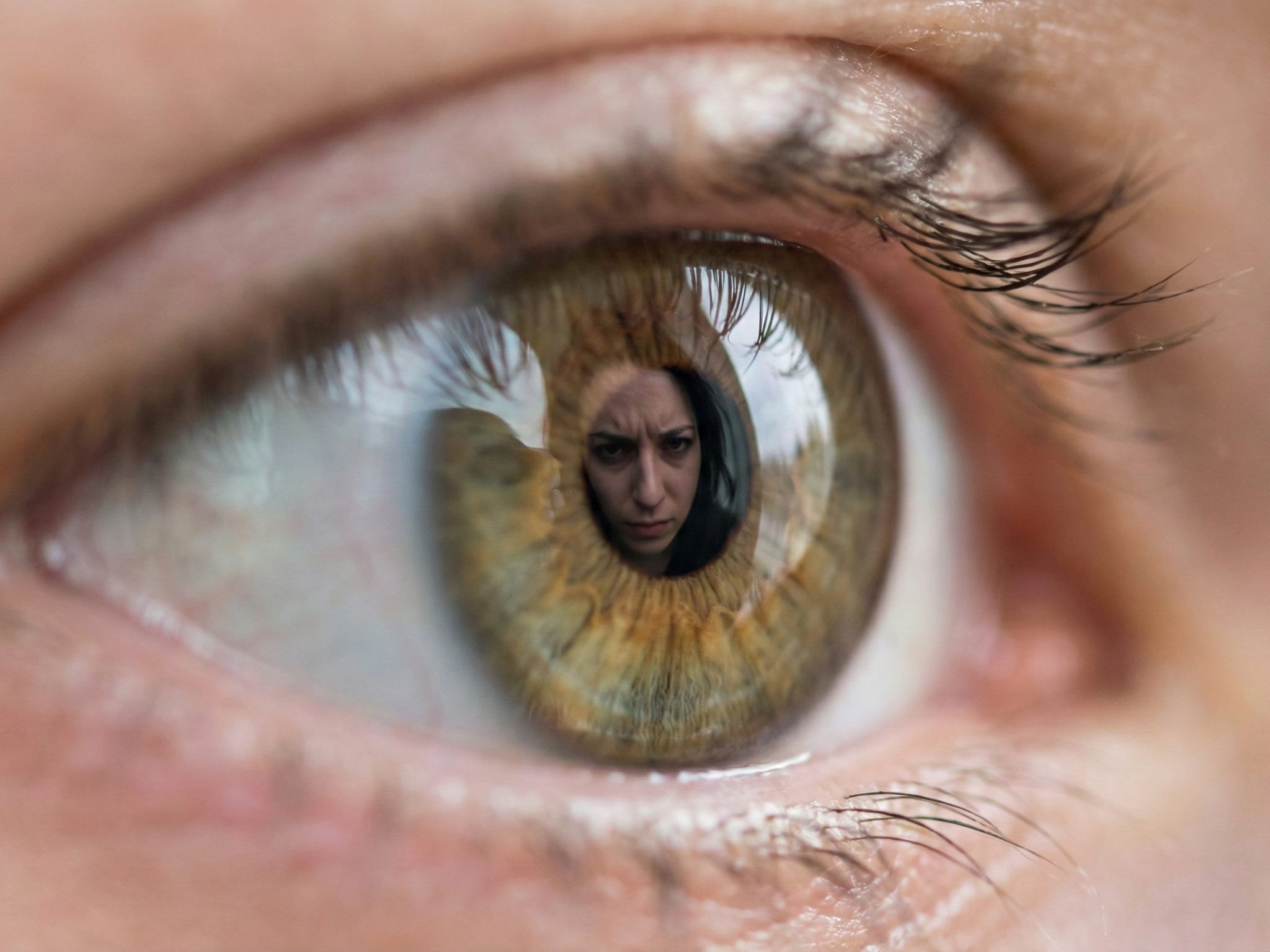
You see your eye with the reflection of your face looking at it, which is not the same thing. You can ask somebody to take a picture of your eye, but what you see in the picture is something like this:
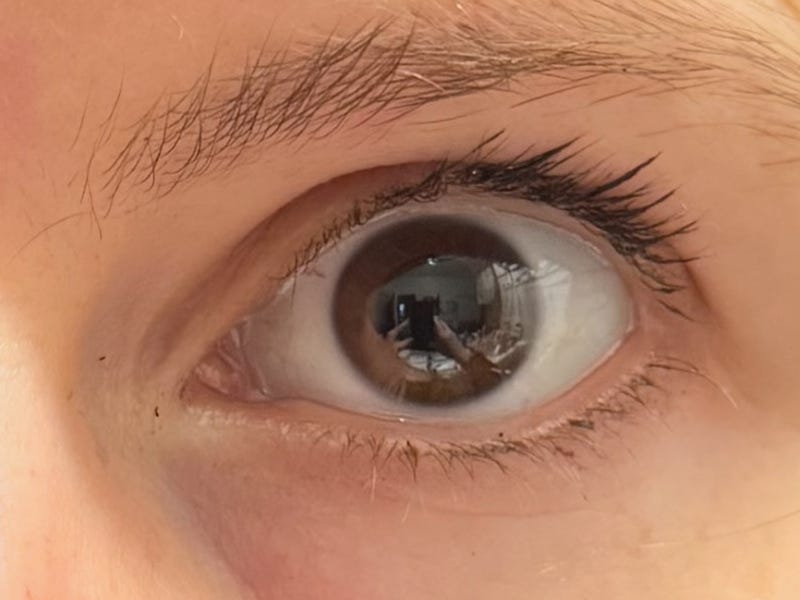
You see your eye with the reflection of a camera pointing at it, which is not the same thing. The previous picture was AI-generated, but this one is real (thank you Daughter!).
This example is not a rigorous demonstration but suggests the idea that any representation (map) of the world must be contaminated by “reflections” of whatever is used to build it.
I'm not dropping out! We are doing it. BLAXXKY is a go - 2026!