

Greetings to all readers and subscribers, and special greetings to the paid subscribers!
Please scroll down for the main topic of this newsletter. But first:
I found a 1995 review of Frank Tipler’s Omega Point cosmology by John Polkinghorne, the physicist/theologian who passed away last year. One of my heroes criticizing another! “Tipler develops his arguments with fantastic ingenuity,” said Polkinghorne. “The book reads like the highest class of science fiction… a remarkable speculative tour de force…”
Polkinghorne summarized Tipler’s theory as:
“the collapse of a closed universe subject to a specific future boundary condition which, roughly speaking, requires the causal network of the universe to condense onto a single ultimate point. This is the Omega Point, which Tipler says plays the role of a ‘physical god’ in the new-style religion. In this closing hectic phase, the whole cosmos will become a computer racing at ever increasing speeds, capable of processing an infinite amount of information and so, in Tipler’s view, capable of producing ‘eternal life’… the Omega Point will use its infinite computing capacity to produce emulations of you and me.”
But (besides other objections) Polkinghorne was persuaded that the “hope of such a resurrection lies not in the curiosity or calculation of a cosmic computer, but in the personal God who cares individually for each of His human creatures.”
I take a middle of the road position. I don’t buy Tipler’s “extreme reductionism” and staunch determinism, but I think a revised theory could show that the Omega Point is very similar to Polkinghorne’s personal God.
I have been going through Tipler’s “The Physics of Immortality” again. For those who don’t have the book there is a decently formatted html version online (too bad the appendices for scientists are missing). I still agree with all I wrote in Chapter 15 - Omega Point: Frank Tipler’s physics of immortality and Christianity of my book “Tales of the Turing Church,” and I still characterize my position as “Soft Tiplerianism.”
Stimulated by a video produced by Sabine Hossenfelder and titled “Does Superdeterminism save Quantum Mechanics? Or does it kill free will and destroy science?” (text version), I have been thinking of determinism again. Is everything predetermined, or does the universe make choices? Do WE make free choices? Am I writing this sentence, or was it already written at the beginning of time? These are, I often think, THE most important open scientific questions.
Hossenfelder is a great science communicator. See my review of her book “Lost in math: how beauty leads physics astray” (2018). I’m impatiently waiting for her next book “Existential Physics.” Great title! But superdeterminism doesn’t make existential sense to me.

I discuss superdeterminism in my book “Tales of the Turing Church.” The “super” prefix is redundant: superdeterminism is just determinism. I’m not blind to the esthetic and emotional appeal of a fully deterministic universe, but my existential preference goes to a creative universe where genuinely new things happen and we are autonomous agents with free will.
Hossenfelder quotes Nicolas Gisin, who summarizes my own position as:
“for me, the situation is very clear: not only does free will exist, but it is a prerequisite for science, philosophy, and our very ability to think rationally in a meaningful way. Without free will, there could be no rational thought. As a consequence, it is quite simply impossible for science and philosophy to deny free will.”
Having said that, I’m thinking of how to make existential peace with the idea of a deterministic universe. Perhaps Wolfram’s ideas on computational irreducibility? Unpredictable determinism seems equivalent to God’s transcendent knowledge of a future that is unknowable to us (even in principle), so if you have no problem with the latter you should have no problem with the former.
This is similar to what C. S. Lewis said on God and time (see also my essay “Time beyond time, out of time”):
“He does not ‘foresee’ you doing things tomorrow; He simply sees you doing them: because, though tomorrow is not yet there for you, it is for Him. You never supposed that your actions at this moment were any less free because God knows what you are doing. Well, He knows your tomorrow’s actions in just the same way—because He is already in tomorrow and can simply watch you. In a sense, He does not know your action till you have done it: but then the moment at which you have done it is already ‘Now’ for Him.”
I’m not persuaded, but I’m thinking. Some of my pet ideas (e.g. all information on everything that ever happens is permanently stored in the fabric of reality) are easier to defend with superdeterminism. I’m thinking of how to harmonize the two perspectives. Gisin has interesting ideas. More soon.
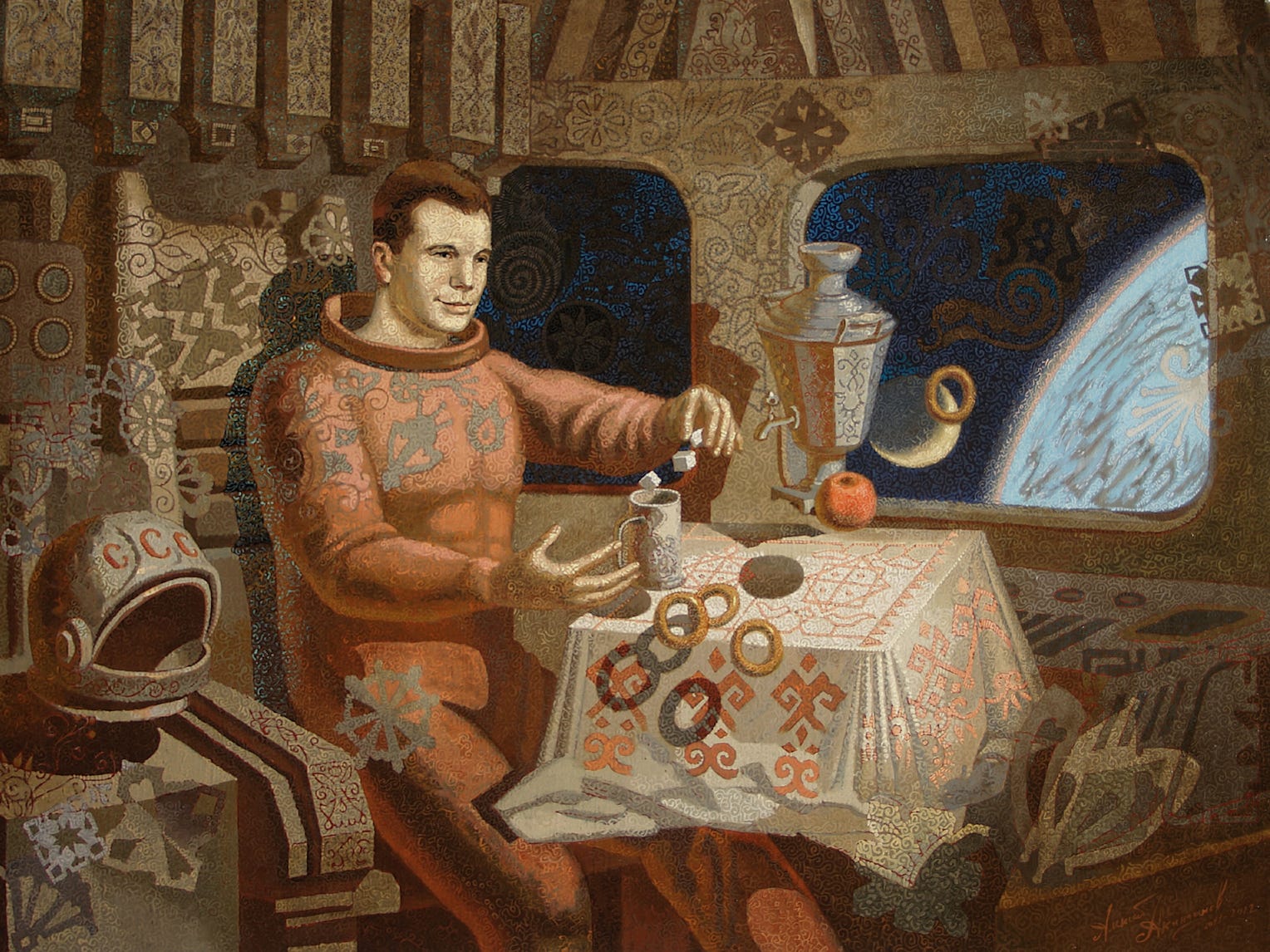

An interesting article by Michel Eltchaninoff, titled “Transhumanisme. Retour vers le futURSS” (unpaywalled copy here) and published in Philosophie magazine, promotes Eltchaninoff’s new book titled “Lénine a marché sur la lune: La folle histoire des cosmistes et transhumanistes russes.”
Eltchaninoff argues that Russian cosmism is a precursor of contemporary transhumanism, and elaborates on modern cosmism. The cosmist idea that we will expand into the universe and become cosmic engineers has inspired and continues to inspire futurists (both thinkers and doers) in both Russia and the West. The article also mentions a new French translation of Nikolai Fedorov’s masterwork: “Philosophie de l'oeuvre commune.”
See Chapter 7 of my book and my recent review of “The Future of Immortality: Remaking Life and Death in Contemporary Russia” by Anya Bernstein.
Last year I exchanged emails with the editors of Philosophie magazine. This is quoted in the article:
“Russian cosmism and transhumanism are very close. Transhumanism inherits from Russian cosmism a deep conviction that we'll advance beyond all limits, expand into space, and resurrect the dead from the past using future science and technology.”
I also told them:
Technological resurrection is not emphasized by many contemporary transhumanists because (and this is a major difference) many transhumanists reject the religious outlook that was central to the thought of Nikolai Fedorov and many Russian cosmists.
From Chapter 10 of my book: “Harrison... concludes that the United States has its counterpart to Russian cosmism, for which no term seems more appropriate than American cosmism...” The first wave of transhumanists in the USA (FM 2030, Max More, etc.) were aware of Russian cosmism but didn't emphasize its more visionary aspects, like technological resurrection. I have stopped using the term "transhumanism" to describe my worldview, now I use "cosmism" instead.
The writings of the Russian cosmists were not available in translation in the 1980/90s when contemporary transhumanism was developed, but second hand accounts were circulated in the futurist community and, I think, influenced Max and other early transhumanists. Max says: “One of the more interesting precursors to transhumanism was Nikolai Fedorovich Fedorov (1829-1903), a Russian Orthodox Christian philosopher and participant in the Russian cosmism movement, who advocated using scientific methods to achieve radical life extension, physical immortality, resurrection of the dead...”
From Chapter 7 of my book: “Goffman and Cornell note that the term ‘cosmism’ was ‘borrowed by Ben Goertzel and Giulio Prisco in 2010 to denote a futurist philosophy more tailored for the modern era...’” There is a modern form of cosmism, but it's not an organized group. There have been attempts to establish organized cosmism (e.g. from my book, Chapter 7: “In 2015 I participated in a conference on ‘Modern Cosmism’ in New York City, organized by Vlad Bowen. George Carey and Ben Goertzel were among the participants. The conference was covered by novelist John Crowley...”) but no followup. I guess cosmists are too individualistic to form groups.
and while some individual will changs mind with evidence, my previous comment stems that most will not, unless some extraordinary discovery is made soon and I am not betting on it.
Giulio, you are right that radical life extension, virtual aferlife and resurrection will happen, but not in the coming decades, but alot later. Because look at the answer from George Harrison on the forum. https://www.quora.com/Is-cryonics-a-bad-idea, here is his profile, https://www.quora.com/profile/George-Harrison-45. I hate to say it, but I agree with Elon Musk. Only when inevitablist biofatalist scientists who believe immortality, cheating death and resurrection are delusions and that transhumanists are just into selling books to psychotic or immature, or for publicity, and that THEIR (those scientists who hold such desbelieving view of indefinite life extension and the view that perpetual life and perpetual youth are like perpetual motion) view is an adult view, therefore is the true one and rational one and compatible with science (and it is despite that 11-12 year olds are often more rational in their judgements on their level on capacity that adults are on adult level of capacity, it is just they don't have enough knowledge and capacity to think long term like adults) will die out and younger, less set in their ways people will join scientific ranks will we see paradigm shift. And after that, you still will need new research within the new paradigm how to stop or reverse aging and death, and bring back the dead, and it will take decades more. So you are right Giulio, it is unlikely in our lifetime because people who think only psychotic people believe it and the ideas are delusional and due to lack of ability to distinguish reality from fantasy will not solve problems and it will take decades for them to die out and decades more to people open to such unearthly ideas to accomplish listed goals.